
Ammo & Guns Blog
357 Magnum for Bear Defense: 7 Honest Facts to Know
357 Magnum for Bear Defense: 7 Honest Facts to Know
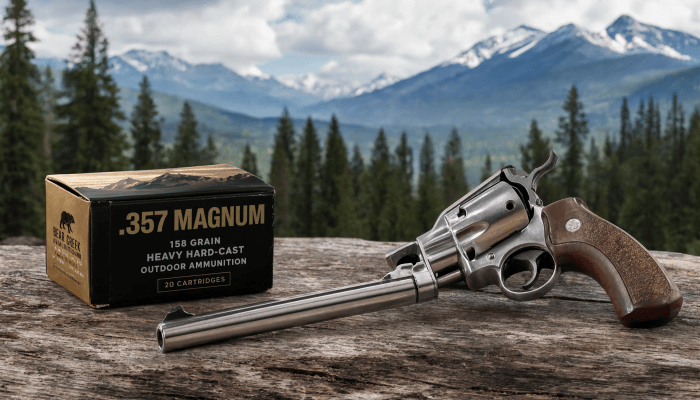
357 Magnum for bear defense is a common topic among hikers, hunters, campers, and handgun owners who spend time in bear country. The short answer is that a .357 Magnum may be considered a minimum handgun option by some outdoorsmen, but it is not the strongest or most forgiving choice.
Bear defense is not just about caliber. It also involves prevention, awareness, legal rules, bear spray, ammunition selection, firearm reliability, and realistic expectations.
For current handgun and ammunition options, browse Handguns, Handgun Ammunition, and Ammunition at Star Gun Shop.
Is 357 Magnum Suitable for Bear Defense?
A .357 Magnum can be carried in bear country, but it is generally viewed as a lower-end option for defensive use against large bears. It may be more reasonable around black bears than in areas with larger brown bears or grizzlies.
Larger handgun calibers such as .44 Magnum, .454 Casull, and other heavy revolver cartridges are often preferred by experienced outdoorsmen because they offer more bullet weight, more energy, and greater penetration potential.
That does not mean .357 Magnum has no role. It means buyers should understand its limits before trusting it as their only protection method.
1. Bear Spray Should Still Be Part of the Plan
Before discussing handguns, it is important to talk about bear spray. Many wildlife agencies recommend bear spray as a primary deterrent for bear encounters because it can create distance without requiring lethal force.
Bear spray should be legal where you travel, carried where it can be reached quickly, and understood before entering bear country. Do not bury it deep inside a pack.
A firearm is a serious last-resort tool. Bear spray, food storage, group awareness, noise, and avoiding surprise encounters are all part of responsible bear-country safety.
2. 357 Magnum Is Often Considered a Minimum Option
The .357 Magnum is more powerful than many common defensive handgun cartridges, but bear defense creates a different standard. Large animals have heavy bone structure, thick muscle, and dense tissue.
For that reason, many shooters consider .357 Magnum a minimum handgun caliber rather than an ideal one. If someone chooses it, they should understand that ammunition selection and firearm familiarity matter greatly.
A light defensive hollow point designed for personal protection is not the same as a deep-penetrating outdoor load.
3. Penetration Matters More Than Expansion
For bear defense discussions, penetration is usually more important than expansion. Many common personal-defense bullets are designed to expand quickly in human-defense scenarios. That may not be ideal for large animal defense.
Outdoor-focused .357 Magnum loads are often built around heavier bullets and deeper penetration. Hard-cast, flat-nose, or solid-style bullets are commonly discussed for this role because they are designed to hold together and drive deeper than many expanding bullets.
Always use ammunition that is safe in your firearm and appropriate for the manufacturer’s recommendations.
4. Bear Size Changes the Conversation
Not every bear encounter presents the same level of risk. Black bears are generally smaller than grizzly or brown bears, though individual size and behavior still vary.
A .357 Magnum may be viewed as more reasonable in black bear country than in grizzly country. In areas with large coastal brown bears or grizzlies, many experienced outdoorsmen prefer stronger handgun calibers or long guns where lawful and practical.
The local bear species, terrain, laws, and activity all affect what equipment makes sense.
5. Recoil and Control Still Matter
One reason some shooters choose .357 Magnum is controllability. Compared with larger magnum revolvers, .357 Magnum usually has less recoil and may be easier for some people to handle.
A powerful handgun that a shooter cannot control is not automatically better. The best defensive tool is one the owner can carry legally, access safely, and operate responsibly under pressure.
That said, controllability does not erase the cartridge’s limitations. The trade-off is lower recoil but less power than larger bear-defense handgun calibers.
6. Barrel Length and Revolver Choice Matter
The same .357 Magnum load can perform differently from different barrel lengths. Short-barreled revolvers may lose velocity compared with longer-barreled options.
Revolver size also affects recoil, sight radius, weight, and carry comfort. A small lightweight .357 revolver may be easy to carry, but it can be harder to control with heavy outdoor loads.
Buyers should consider the whole setup, not just the caliber name.
7. Know the Legal and Practical Limits
Bear defense laws vary by state, park, public land type, and local regulation. Some locations have strict rules about firearms, defensive use, hunting seasons, and ammunition types.
Before carrying a handgun in bear country, confirm the rules for the exact area you plan to visit. National parks, national forests, state parks, and private lands may follow different rules.
If you are traveling across state lines, check each jurisdiction before the trip.
Better Questions Than “Is 357 Magnum Enough?”
Instead of asking only whether .357 Magnum is enough, ask these questions:
-
What bear species live where I am going?
-
Is bear spray legal and accessible?
-
What are the firearm rules for that area?
-
Is my ammunition designed for deep penetration?
-
Can I handle this revolver safely and responsibly?
-
Is a larger caliber more appropriate for the risk level?
-
Have I practiced safe storage, transport, and field awareness?
These questions lead to a better decision than caliber alone.
357 Magnum vs Larger Bear-Defense Calibers
Compared with .44 Magnum or .454 Casull, the .357 Magnum usually offers less bullet weight and less energy. That makes it easier to control but less powerful.
The .44 Magnum is often viewed as a more common revolver choice for serious bear-country handgun carry. The .454 Casull and similar cartridges offer even more power, but they also bring more recoil, cost, and practice demands.
A larger caliber is not automatically the best answer for every person, but it does offer more margin when the shooter can handle it responsibly.
Final Verdict
357 Magnum for bear defense can be a workable minimum option in some circumstances, especially around smaller bears and with proper outdoor-oriented ammunition. However, it is not the most powerful or most forgiving handgun choice for large bear country.
If you choose .357 Magnum, understand its limits. Consider bear spray, local laws, bear species, ammunition design, firearm reliability, and your ability to handle the revolver safely.
For related options, browse Handguns, Handgun Ammunition, and Ammunition at Star Gun Shop.
Always use ammunition that matches your firearm’s marked caliber. Buyers are responsible for following all federal, state, and local laws before purchasing firearms or ammunition.
