

Ammo & Guns Blog
Shotgun Versus. Rifle: Which is Best For Home Defense?
Shotgun vs Rifle for Home Defense: 7 Key Factors
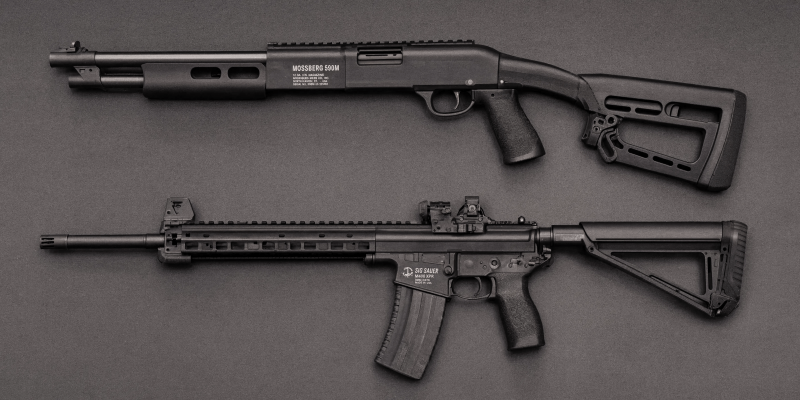
Shotgun vs rifle for home defense is a common question for firearm owners comparing long guns for lawful home protection. There is no single answer that fits every household. The better choice depends on firearm experience, recoil tolerance, storage plan, local laws, ammunition choice and training.
Shotguns and rifles were designed around different strengths. A shotgun is often associated with close-range versatility and shotshell options. A rifle is usually associated with easier aiming precision, higher capacity in many modern platforms and lower recoil in certain calibers.
This guide compares both options in a practical, safety-focused way so buyers can make a more informed decision.
Shotgun vs Rifle for Home Defense: Quick Comparison
| Factor | Shotgun | Rifle |
|---|---|---|
| Common role | Close-range long gun option | Precision-focused long gun option |
| Recoil | Can be heavy, especially in 12 gauge | Often lighter in .223/5.56 platforms |
| Ammunition | Buckshot, slugs, birdshot, specialty loads | Centerfire rifle cartridges |
| Capacity | Often lower, depending on model | Often higher, depending on model and state laws |
| Training need | Pump-action use requires practice | Semi-auto rifles also require training |
| Storage | Requires secure long-gun storage | Requires secure long-gun storage |
| Best fit | Experienced shotgun users | Experienced rifle users |
For related options, browse Shotgun Ammo or Rifle Ammunition at Star Gun Shop.
1. Ease of Use
The first factor in shotgun vs rifle for home defense is ease of use. Many people assume a pump-action shotgun is the simplest choice. In reality, pump-action shotguns require proper practice. Short-stroking the action, failing to cycle fully or mishandling the safety can create problems for inexperienced users.
A semi-automatic rifle may be easier for some owners to handle, especially if it has lighter recoil and familiar controls. However, rifles also require training. The user must understand loading, unloading, safe handling, sighting system, magazine function and maintenance.
The best firearm is the one the lawful owner can handle safely and confidently.
2. Recoil and Control
Recoil matters. A 12 gauge shotgun can produce strong recoil, especially with heavy loads. That can make follow-up shots slower and can discourage regular practice.
Many rifles chambered in .223 Remington or 5.56 NATO have lighter recoil than a 12 gauge shotgun. This may make them easier for some owners to control. However, rifle noise, muzzle blast and ammunition choice still matter.
Buyers should choose a firearm they can safely control, not one chosen only because it sounds powerful.
3. Ammunition Choice
Ammunition selection is another major part of the shotgun vs rifle for home defense debate. Shotguns may use buckshot, slugs or lighter shotshell loads. Rifles use centerfire cartridges designed for rifle platforms.
The right ammunition depends on the firearm, local laws, safe-use considerations and manufacturer guidance. Do not assume all ammunition of the same gauge or caliber performs the same way.
For technical ammunition standards, buyers can review SAAMI standards.
4. Handling Indoors
Long guns require space to handle safely. Shotguns and rifles are both longer than handguns, so buyers should consider firearm length, storage access and safe handling inside the home.
Shorter firearms may be easier to move and store, but buyers must still follow all federal, state and local laws. Any firearm used for lawful protection should be stored securely and accessed only by authorized adults.
This article does not provide tactical room-clearing or confrontation advice. For real-world safety, training from qualified instructors is important.
5. Capacity and Reloading
Capacity can differ widely between shotguns and rifles. Many defensive-style shotguns hold fewer rounds than modern semi-automatic rifles. However, laws and magazine restrictions vary by state.
Shotguns with tubular magazines may require different loading habits than detachable-magazine rifles. Rifles with detachable magazines may be faster to reload for trained users, but magazine storage and legal restrictions must be considered.
The better option depends on training, legal limits and the specific firearm model.
6. Reliability and Maintenance
Both shotguns and rifles can be reliable when properly maintained. A quality pump-action or semi-automatic shotgun can be dependable, but the shooter must know how to operate it correctly.
Rifles can also be reliable, especially when cleaned, lubricated and paired with compatible ammunition and magazines. Poor maintenance, worn parts or low-quality magazines can reduce reliability in any firearm platform.
Reliability should be tested at the range in a safe, legal setting before trusting any firearm for serious use.
7. Safe Storage and Legal Responsibility
Safe storage is not optional. A firearm chosen for home defense still needs to be secured from children, visitors and unauthorized users. Project ChildSafe recommends locked storage and responsible firearm security practices.
Buyers should also review ATF firearm safety guidance and follow all federal, state and local laws. Legal requirements for firearm ownership, storage, transport and transfer can vary by location.
For broader buyer guidance, read our How to Buy Guns Online guide or compare more options in Firearms.
Shotgun Advantages
A shotgun may be a good fit for experienced owners who already train with shotguns and understand shotshell selection. Shotguns offer broad ammunition variety and are available in many sporting, hunting and defensive-style configurations.
A shotgun can also be familiar to buyers who already use one for hunting or sport shooting. Familiarity matters because confidence and safe handling are more important than internet opinions.
Rifle Advantages
A rifle may be a better fit for owners who want lighter recoil, easier precision and a platform they can train with consistently. Many modern rifles are modular, optics-ready and easier for some shooters to control than heavy-recoiling shotguns.
A rifle also gives buyers a clear sighting system and familiar controls if they already train with that platform. Still, rifle selection should be based on lawful ownership, safe storage and responsible use.
Final Verdict: Shotgun vs Rifle for Home Defense
The answer to shotgun vs rifle for home defense depends on the person, not just the firearm. A shotgun can be a strong option for trained shotgun users. A rifle can be a strong option for trained rifle users.
Choose the firearm you can store securely, operate safely, maintain properly and train with regularly. Also consider recoil, ammunition availability, household safety, legal restrictions and local requirements before buying.
For many owners, the best choice is not the most powerful firearm. It is the firearm they can use responsibly, lawfully and safely.
